
HEALTH & NUEROSCIENCE
The neuroscience impacts of drinking alcohol are complex and multifaceted, affecting the brain's structure, function, and chemistry in various ways.
The extent of these impacts depends on factors such as the amount and frequency of alcohol consumption, genetic predisposition, and overall health.
Section 1: Neurotransmitters
A neurotransmitter is a chemical messenger that transmits signals across a chemical synapse, such as a neuromuscular junction, from one neuron (nerve cell) to another “target” neuron, muscle cell, or gland cell. Neurotransmitters are crucial for the communication between neurons and play a key role in the functioning of the nervous system. Neurotransmitters are essential for the brain to process information and for the body to function properly.
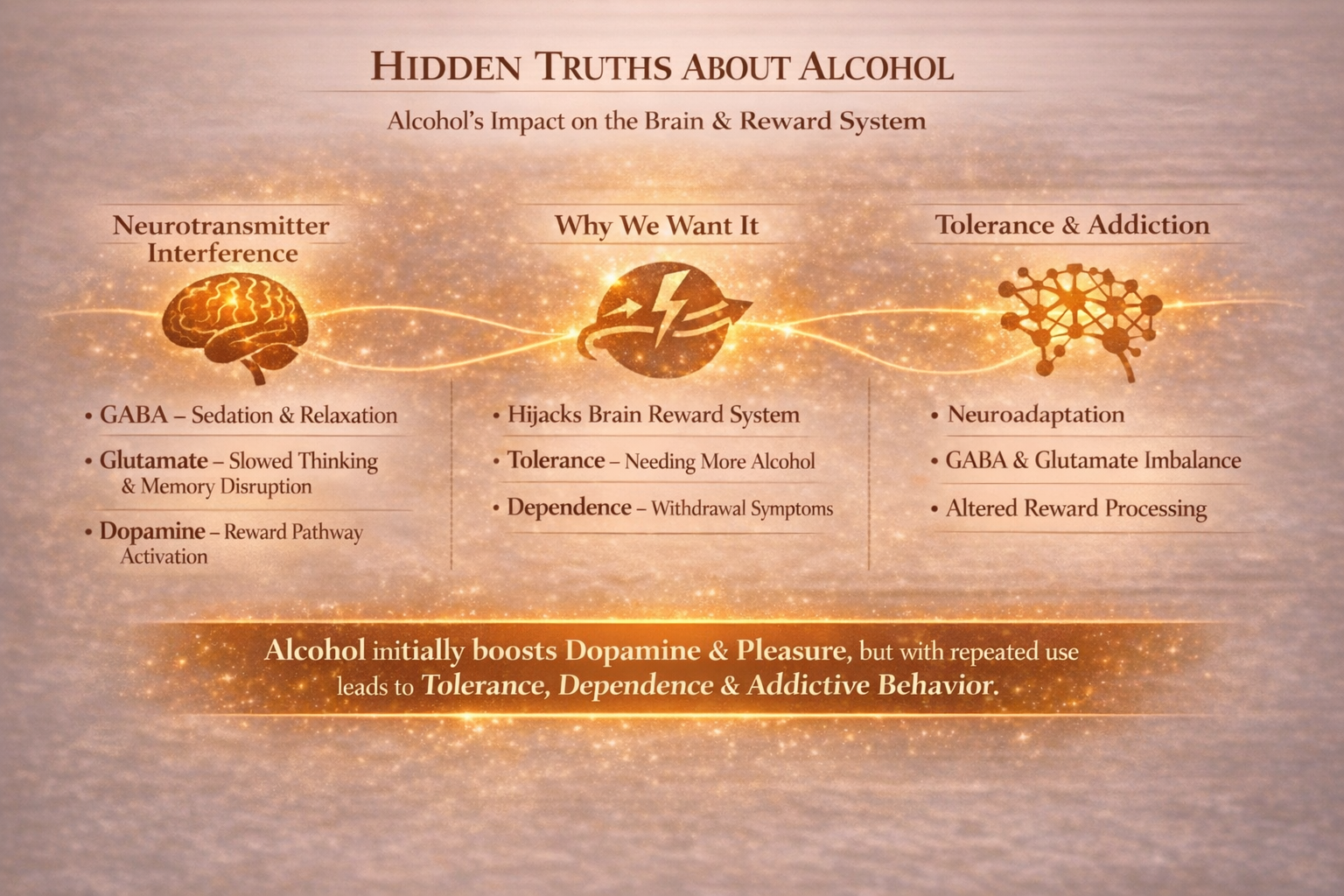
Alcohol creates significant Neurotransmitter Interference.
GABA: Alcohol amplifies calming signals in the brain → relaxation and sedation.
Glutamate: Alcohol suppresses excitatory signaling → slowed thinking, memory disruption, blackouts.
Dopamine: Alcohol stimulates the reward pathway → reinforcing the urge to drink again.
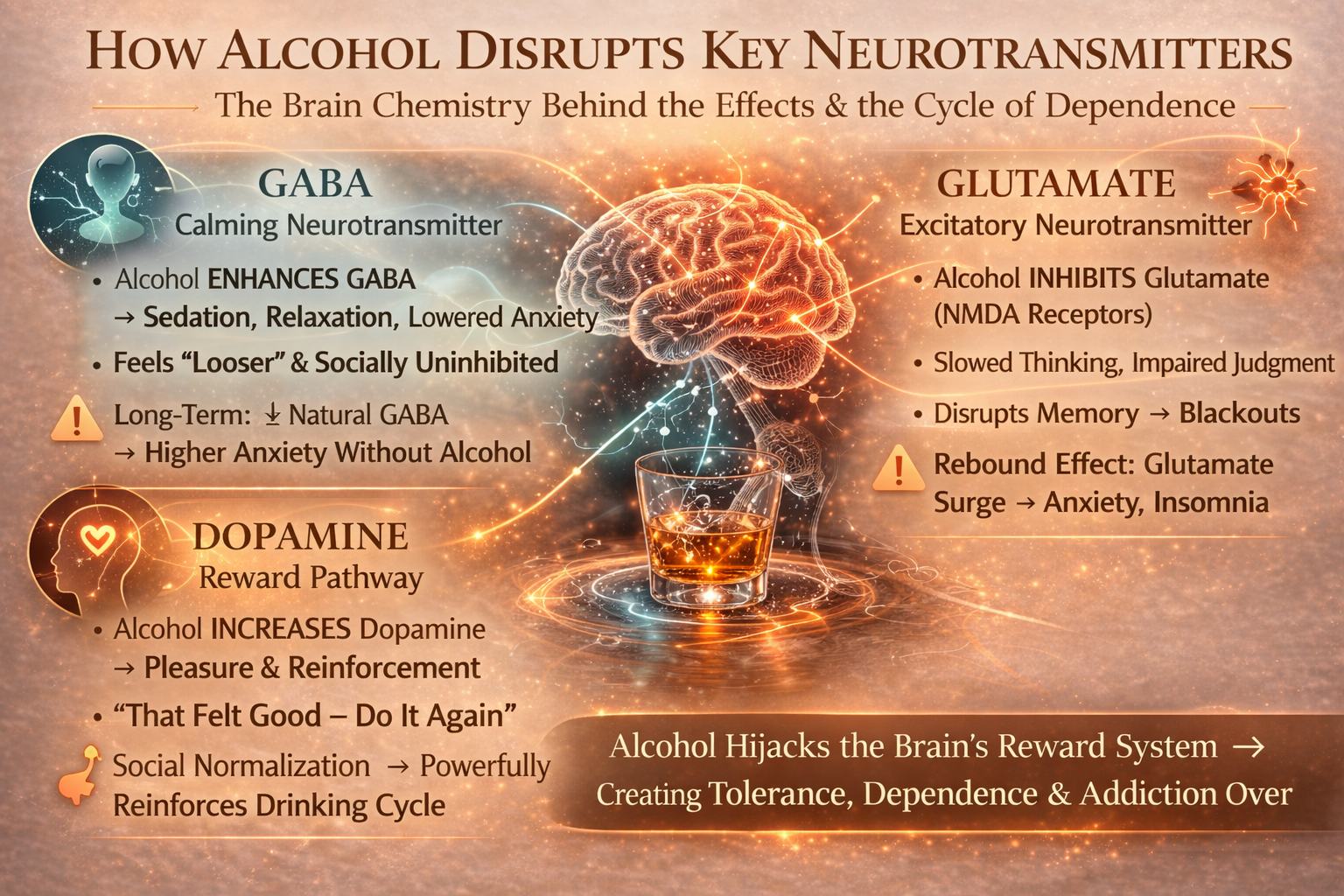
GABA - Alcohol enhances the effects of GABA (gamma-aminobutyric acid), an inhibitory neurotransmitter, which leads to sedative and calming effects.
Alcohol is a GABA agonist/modulator → it enhances GABA activity.
This slows brain firing → sedation, relaxation, lowered anxiety.
It’s why people feel “looser” or socially uninhibited.
Longer-term: Brain reduces natural GABA sensitivity → baseline anxiety can increase without alcohol.
GLUTAMATE - Alcohol inhibits the action of glutamate, the primary excitatory neurotransmitter. This inhibition disrupts cognitive functions, memory formation, and can lead to blackouts.
Alcohol inhibits glutamate, especially NMDA receptors.
This suppresses brain excitation → slowed thinking, impaired judgment.
Memory encoding gets disrupted → blackouts can occur.
Rebound effect: When alcohol wears off, glutamate can surge → anxiety, restlessness, insomnia.
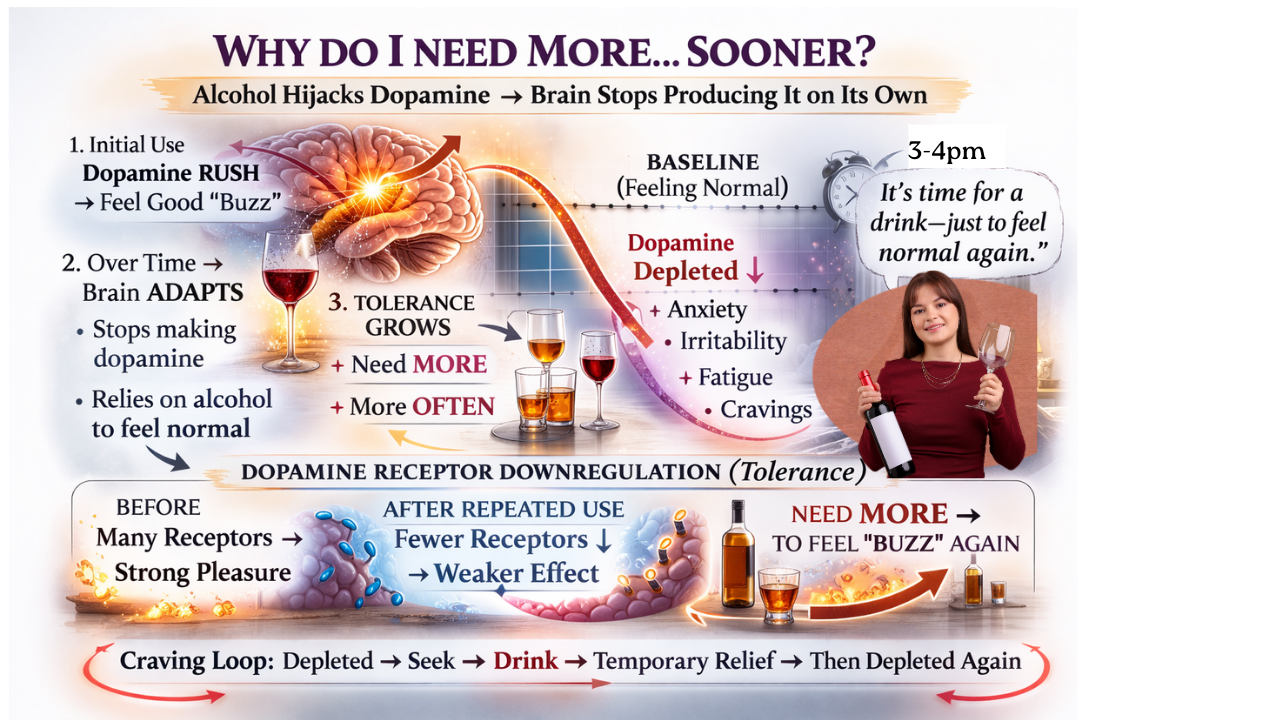
DOPAMINE - Alcohol increases dopamine levels in the brain’s reward pathway, which can lead to feelings of pleasure and reinforcement of drinking behavior, which can contribute to addiction.
Alcohol increases dopamine in the mesolimbic reward pathway!
This reinforces drinking behavior → “that felt good, do it again.”
However: Because alcohol is socially normalized and repeatedly used, the reinforcement loop becomes powerful over time.
How Neurotransmitters Work
Synthesis: Neurotransmitters are synthesized from precursors, usually in the cell body of the neuron or the synaptic terminal.
Storage: Once synthesized, neurotransmitters are stored in synaptic vesicles, which are small sacs in the axon terminal of the neuron.
Release: When an action potential (an electrical signal) reaches the axon terminal, it triggers the release of neurotransmitters into the synaptic cleft (the small gap between neurons).
Binding: The released neurotransmitters bind to specific receptors on the membrane of the target neuron (post-synaptic neuron).
Response: Binding of neurotransmitters to receptors can trigger various responses in the target neuron, such as initiating a new action potential, modulating neuronal excitability, or triggering intracellular signaling pathways.
Termination: The action of neurotransmitters is terminated by their reuptake into the presynaptic neuron, enzymatic degradation, or diffusion away from the synaptic cleft.
Types of Neurotransmitters
Excitatory Neurotransmitters: These increase the likelihood that the target neuron will fire an action potential. Examples include glutamate and acetylcholine.
Inhibitory Neurotransmitters: These decrease the likelihood that the target neuron will fire an action potential. Examples include gamma-aminobutyric acid (GABA) and glycine.
Modulatory Neurotransmitters: These can modulate the effect of other neurotransmitters. Examples include dopamine, serotonin, and norepinephrine.
Examples of Neurotransmitters
Acetylcholine: Involved in muscle activation, learning, and memory.
Dopamine: Plays a role in reward, motivation, and motor control.
Serotonin: Influences mood, appetite, and sleep.
Norepinephrine: Affects attention and responding actions in the brain.
Glutamate: The main excitatory neurotransmitter, involved in cognitive functions such as learning and memory.
GABA: The main inhibitory neurotransmitter, involved in reducing neuronal excitability.
Section 2: Why We Want It
Alcohol alters the brain’s reward system, making it more sensitive to alcohol’s reinforcing effects. This can lead to the development of tolerance (needing more alcohol to achieve the same effects) and dependence (experiencing withdrawal symptoms without alcohol).
THE SUBSTANCE
Alcohol as we know and drink it is a diluted version of Ethanol. Ethanol (C₂H₅OH), is a psychoactive substance that is the main and active ingredient in beer, wine, and spirits. It is produced through the fermentation of sugars by yeasts. Ethanol is a mild industrial poison and is being sold everywhere and sold as a conduit to companionship & joy.
Why We Feel Drunk
Alcohol crosses the blood-brain barrier and attaches to receptors in the brain that slow down brain function. This can make you feel relaxed and calm. Alcohol also stimulates the release of dopamine and serotonin, which are the yummy, feel good hormones.
These make you feel happy, more social, and confident. That’s “the buzz”.
Releasing Dopamine
Dopamine links a positive emotion to certain things to ensure we want to experience them again and again. Alcohol causes the brain to release dopamine. This initially makes people feel relaxed and confident, braver, less critical of themselves and others. We feel good…just like the commercials, those initial sips release the “buzz” and we feel good. The brain’s reward system is gifted with a state of pleasure therefore reinforcing the behavior. This encourages repeated use, leading to addiction.
Affecting Judgment (Being Uninhibited — Liquid Courage)
Alcohol can weaken a person’s sense of judgment, which can lead to risky or unsavory behaviors. “Allowing us” to take the overwhelm out of making decisions, and it becomes easy to just do or think or say things that we likely wouldn’t in an alcohol-free state. As the concentration of alcohol in the bloodstream increases, we also experience more negative feelings, such as anger, depression, or anxiety.
Addictive Attributes
Alcohol, particularly ethanol, can have profound addictive qualities and impacts on the human body. Alcohol has a significant impact on the dopamine systems in the brain, which plays a crucial role in the regulation of reward, pleasure, and motivation — The Human Reward System.
Human Reward System (HRS)
Has evolved over eons from survival to pleasure. Today there are so many more pleasure-inducing rewards such as chocolate, sugar, pornography, social media, gambling, etc. There are multi billion dollar industries around creating rewards that release Dopamine.
Increased Cravings
Due to the changes in the natural release of dopamine, we drinkers then begin to experience strong cravings for alcohol. This is driven by the brain’s reward system signaling a need for the substance to restore the lowered dopamine levels to what the brain has adapted to expect.
Anhedonia
Anhedonia is the inability to feel pleasure. This is due to the reduced dopamine activity in the brain, making it more and more challenging for individuals to find enjoyment in previously pleasurable activities.
Anhedonia: AN meaning without and EDONIA meaning pleasure, so a complete or partial inability to derive pleasure from things. It is that feeling of lack of interest, enjoyment or pleasure from life’s experiences. Or you seek out only activities that are associated with what gives you pleasure…and that is now scientifically associated with alcohol. So, you are ‘naturally’ seeking only the things that will feed your reward system that is has been tied to a drink.
How GABA and Glutamate Drive Cravings (Alongside Dopamine)
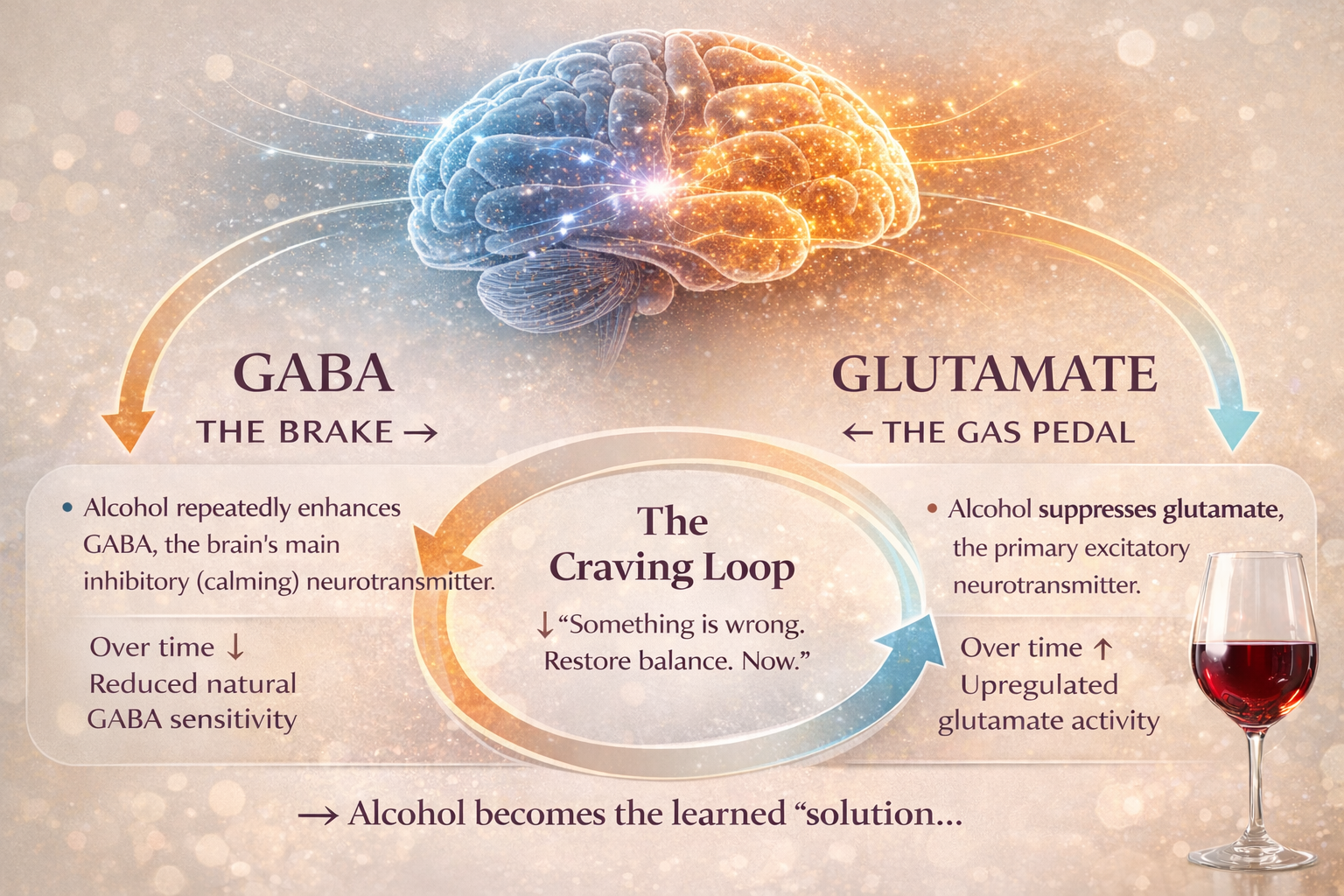
Increased Cravings don’t come from dopamine changes alone. They’re amplified by alcohol’s push-pull effect on GABA and glutamate, the brain’s primary calming and activating systems.
GABA (The Brake)
Alcohol repeatedly enhances GABA, the brain’s main inhibitory (calming) neurotransmitter. Over time, the brain adapts by reducing its own natural GABA sensitivity.
Without alcohol, the nervous system feels overstimulated, tense, anxious, or restless.
The brain learns that alcohol is the fastest way to “apply the brakes” again.
This discomfort is interpreted as a craving, not for pleasure—but for relief.
Glutamate (The Gas Pedal)
Alcohol suppresses glutamate, the primary excitatory neurotransmitter responsible for alertness, focus, and decision-making.
With repeated drinking, the brain compensates by upregulating glutamate activity.
When alcohol leaves the system, glutamate rebounds too strongly.
This creates mental agitation, racing thoughts, irritability, and insomnia.
The Craving Loop
When dopamine drops and GABA is underpowered and glutamate is overactive, the brain sends a clear signal:
“Something is wrong. Restore balance. Now.”
Alcohol becomes the learned solution—not because it feels good anymore, but because it temporarily quietens glutamate, boosts GABA, and lifts dopamine just enough to feel “normal.”
Why Cravings Feel Urgent (And Not Logical)
Cravings are not a moral failure or a lack of willpower.
But rather, cravings (sometimes even subconscious!) are the brain requesting a substance it has adapted to depend on for regulation.
This is why cravings can show up as:
• Anxiety rather than desire
• Irritability rather than pleasure-seeking
• A sense of needing relief, not wanting a drink
The brain isn’t asking for alcohol to celebrate. It’s asking for alcohol to stabilize a nervous system that has been trained to rely on it.
Section 3: The Tolerance & Addiction
Over time, the brain adapts to the presence of alcohol. This is called neuroadaptation and it involves changes in neurotransmitters: GABA (gamma-aminobutyric acid) and Glutamate. These changes contribute to tolerance and dependence; defined here as needing more of the substance to achieve the same effect.
In summary, alcohol initially increases dopamine release, creating pleasurable effects. However, with repeated use, it leads to adaptations in the brain’s dopamine pathways and the entire reward system that result in tolerance, dependence, and altered reward processing. This contributes to the body’s addiction to the substance.
Addiction or Addictive Substance?
As our joy is depleting we seek more and more of the source that was providing the pleasure before. Yet, the alcohol trickery has convinced our brain to stop producing dopamine on its own, so it relies on the alcohol to do it, yet we physically have become more adapted (our tolerance has grown) and we require more and more frequently — just to get to baseline (make the pain go away)…and it takes more volume to get just to the baseline a.k.a - ‘the buzz’ feeling of ‘pleasure’.
Dopamine Receptor Downregulation (a.k.a. Tolerance)
Our brains are efficient and therefore it adapts to the increased levels of dopamine by reducing the number of dopamine receptors. This process is known as downregulation. As a result, the same amount of alcohol will produce a diminished effect over time, leading to tolerance.
Reduced Dopamine Levels
Over time, alcohol use leads to reduced baseline levels of dopamine. This reduction is due to the brain's adaptation mechanisms, where it is trying to balance the heightened dopamine activity caused by repeated alcohol consumption.
Altered Dopamine Pathway Function
Alcohol use alters the normal functioning of dopamine pathways, leading to impairments in reward processing. This alteration affects the HRS, making it difficult for individuals to experience pleasure from activities that they once found enjoyable.
Dependence and Withdrawal
The alterations in the dopamine system contribute to the development of alcohol dependence. When alcohol use is reduced or stopped, the reduced dopamine levels and receptor downregulation can lead to withdrawal symptoms, including dysphoria, irritability, and cravings. These withdrawal symptoms further reinforce the cycle of addiction as individuals may continue to drink to avoid these negative feelings.
Dysphoria Definition:
Is a mental state in which a person has a profound sense of unease or dissatisfaction. While not a mental health diagnosis on its own, dysphoria is a symptom associated with a variety of mental illnesses, some of which include stress, anxiety, depression, and substance use disorders.
-
Our downloads have everything you need to supplement this course.